
Table of Contents
Agentic Commerce is a new model of buying and selling where AI agents such as ChatGPT, Gemini, and other AI models search, compare, and recommend products to consumers directly within a conversation, before guiding them to purchase. Shopify rolled this out in full through Agentic Storefronts starting March 2026, and traffic from AI channels has already grown 8x, with orders up nearly 13x year-over-year in a single quarter. Brands whose backend systems aren’t yet structured for AI to “read” their products correctly simply won’t be mentioned in these conversations at all. What your business needs to do right now is check whether your product data is actually ready for this channel.
When Customers Start Asking AI Instead of Searching Google Themselves
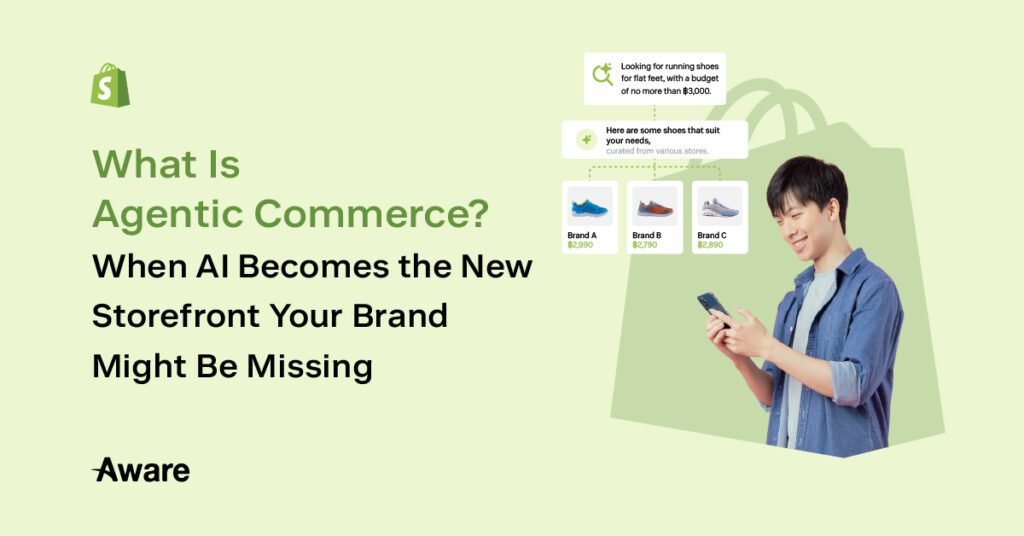
We’ve reached the point where a customer opens ChatGPT and types, “I need running shoes for flat feet, budget under 3,000 baht.” Instead of comparing just the 3 brands they already know, AI now pulls from millions of products worldwide and delivers an answer within secondsม without the customer ever opening Google.
The question this behavior raises is simple: if your brand’s products aren’t part of the dataset AI can see, it won’t matter how good your SEO is or how polished your product pages look — you won’t get mentioned once in that conversation. This is no longer a distant, future concern. Shopify only just rolled this feature out to every merchant in late March.
Why Agentic Commerce Is Already Affecting Real Business Results
Shopify reported that in Q1 2026, traffic from AI channels grew 8x year-over-year, while orders originating from AI-powered search grew nearly 13x in the same period. These numbers matter because they come straight from the platform’s own logs, not estimates.
What’s even more interesting: new buyers coming through AI channels convert at nearly 50% higher rates than traditional organic search traffic. In simple terms, AI channels aren’t just bringing back existing customers, they’re introducing entirely new buyers to your products who never knew your brand before.
For businesses whose marketplace acquisition cost (the total cost of getting one order through a marketplace) keeps climbing every year, this growing channel is an opportunity that comes with a lower price tag, on one condition: your backend systems have to feed AI accurate, readable data from the start. And importantly, selling through AI channels doesn’t mean losing control of your customers. The merchant still owns the customer relationship and all the data, the only thing that’s changed is where discovery happens: inside a conversation instead of a traditional search results page like Google’s.
How Agentic Commerce Actually Works
From Discovery to Purchase: A Shorter Path, Not a Disappearing One
In practice, Agentic Storefronts let AI help customers “search, compare, and reach an initial decision” within the chat itself. Once they’re ready to buy, the system routes them to an in-app browser or a new tab to complete the transaction on the merchant’s own checkout page, complete with the merchant’s branding, pricing, and payment methods. This isn’t a transaction happening loosely inside the chat with no connection to the store’s systems. That distinction matters, because it means merchants retain full control over the backend experience and order data, with clear attribution showing exactly which orders came from ChatGPT, Copilot, or Gemini.
Who's Responsible for What in This Equation
Shopify positions itself as the central infrastructure, syncing stock and pricing in real time across every AI channel at once, without merchants needing to build separate integrations for each platform. The merchant remains the merchant of record — still responsible for fulfillment, product guarantees, and after-sales service exactly as before.
The Early-Mover Advantage
In Thailand, fully completing payment inside a ChatGPT conversation (via Shop Pay) is still being rolled out gradually. But there’s something every Thai brand can — and should — do right now: AI Engine Optimization. This ensures that when a Thai customer types a product search into ChatGPT or Copilot, the AI pulls products from your Shopify store as one of its top recommendations, sending that customer straight to your site to complete the purchase. Any brand whose backend isn’t ready for this today risks missing out on sales from what may be the fastest-growing channel available.
Why AI Has to "Read" Your Products Before It Can Recommend Them
This is the part many brands overlook. AI isn’t smart enough to guess what your product is if your backend data isn’t structured to be easily read. Shopify addresses this with two main tools:
Knowledge Base App
A free app that lets merchants set the FAQs AI shopping agents use to answer customer questions across Shop, ChatGPT, Copilot, Gemini, and Perplexity. It comes with a Query Log that separates questions AI could answer (Answered) from those it couldn’t (Unanswered). One important thing to know: this tool only makes AI’s answers more accurate; it doesn’t automatically make your brand get surfaced more often. The two are separate matters.
Combined Listings
It is built for brands with many product variants (color, size, model). This feature combines up to 2,000 variant option values from up to 60 products into a single page, so AI can see the full product picture in one query instead of reading through pages one by one.
Put simply, having a Shopify store doesn’t automatically mean AI will recommend you. It’s your product data structure that determines how well AI can “see” and “understand” your brand, and that, in turn, determines your odds of being surfaced first, fast and accurately, in every conversation.
Which Businesses Have the Advantage Right Now
The businesses gaining the fastest advantage are brands with a clear, well-organized product catalog (whether selling directly through Shopify or via Shopify Catalog if they’re on another platform) and a team ready to maintain FAQs that match real customer questions. Brands without clear data structure yet should start by organizing their catalog before switching on AI channels, doing it in the reverse order just means redoing the work later.
Aware's Perspective on This
From our experience helping organizations build out their e-commerce systems, the real question in this new era isn’t “how do we get AI to recommend our brand”. It’s “is our current product data actually ready for AI to pull from and answer customers correctly?” Having a Shopify store today isn’t just about a polished-looking site anymore; it requires going deeper into technical SEO and data structuring on the backend. If your product data is scattered, AI will either take longer to process it or may simply skip your brand altogether. That’s why organizing your data properly matters so much. It lets AI see and understand your full product range in a split second, which is what makes your brand stand out as a top pick in conversations, ahead of competitors whose backend isn’t ready.
On the flip side, many brands rush to jump on this trend without first going back to clean up and organize their product catalog. With data still scattered across different pages, they run into a different problem: AI ends up recommending their products incorrectly, or simply leaves them out of the conversation altogether. Letting inaccurate data slip through from the start like this damages brand credibility and costs more business opportunity than not being visible to AI at all. No matter how powerful a hub Shopify is, if your backend catalog isn’t properly structured, flipping on new features won’t help your brand much. So what actually prepares a business for the Agentic Commerce era isn’t rushing to get onto every AI channel as fast as possible. It’s going back to structure your product data so it’s as easy as possible for AI to “read and understand,” before you start chasing new channels.
Want Your Brand to Be the "First Choice" AI Recommends in Every Conversation?
Start preparing your backend for the Agentic Commerce era today, with Aware. We help you design and restructure your product data, and set up your Shopify Catalog correctly, accurately, and in a way that’s easy for every AI platform to read, turning AI-driven traffic into real sales for your business.
Talk to an Aware expert, or start building the foundation of your Shopify system today.
Frequently Asked Questions About Agentic Commerce in Thailand
In traditional e-commerce, customers spend time searching, comparing prices, and reading reviews across multiple pages themselves. In the Agentic Commerce era, customers simply tell an AI (like Gemini, ChatGPT, or Copilot) what they need, and let it search, compare features, and select the best products to present in a single conversation, before directing them to complete the purchase on the brand’s own store.
No, you don’t need to migrate your existing system entirely. For Thai brands already running on another platform (such as WooCommerce, Magento, or a custom backend), you can use Shopify’s Agentic Plan to bring just your product catalog into Shopify’s central catalog, opening the door for leading AI systems like ChatGPT and Gemini to pull your product data and recommend it to consumers as well.
As of now in Thailand (content prepared in July 2026), payment is completed on your own website’s checkout page (Shopify is gradually rolling out Shop Pay for Thailand). When a customer decides to buy from within the chat, the system opens a small in-app browser window or a new tab, letting the customer pay through whatever payment methods you’ve set up (such as scanning a PromptPay QR code, credit card, or TrueMoney). This is actually a good thing for your brand, you remain in full control of the backend experience and retain 100% of the order and customer data yourself.
Not directly. Knowledge Base acts like a “brand manual,” helping AI answer questions or provide accurate information about your brand when asked. Whether AI decides to surface your products as a top recommendation, though, depends primarily on how well your product catalog data (color, size, model, stock status) is structured on the backend.
Start by getting your own backend data in order first. Check whether your current product data structure, product names, descriptions, colors, sizes, prices, and stock counts, is organized and systematic enough for AI to easily scan and understand. No matter how well you integrate with AI, if your backend catalog is disorganized, AI will give customers incorrect information, which damages brand credibility more than simply not being visible to AI at all.
Start by asking yourself the same question we opened with: “If a customer opened an AI platform right now and searched for the type of product you sell, would your brand be the first name AI recommends?” Try searching for your own products there first. If you’re not sure, or you already know your backend and product catalog aren’t organized well enough for AI to use accurately, the Aware team is happy to help analyze and set up your backend, from the first step of data structuring through to building out your Shopify system, to get your brand ready to be the top choice in every conversation with today’s customers. Reach out to the Aware team to talk through the details.

Digital Marketing Executive | Aware Group
At Aware Group, we deliver valuable, easy-to-understand content for everyone—whether you’re tech-savvy or just getting started. No prior technical knowledge? No problem! Learn with us as we explore insightful technology stories. Join us on this exciting learning journey!