Table of Contents
Shopify Plus vs Adobe Commerce Explained
When you’re moving beyond basic e-commerce, two options stand out: Shopify Plus and Adobe Commerce (formerly Magento Enterprise). Both can support eight-figure GMV, complex catalogs, and international expansion.
The difference is how they operate and what it takes to run them. Shopify Plus is a fully managed SaaS platform built for speed, conversion, and low overhead. Adobe Commerce is a highly customizable application that offers deep control but adds complexity and upkeep.
This guide walks through the trade-offs across architecture, customization, operating model, and total cost of ownership. Use it to choose the platform that fits your business model, team, and growth plan.
For most fast-growing brands that need to move quickly, iterate often, and protect margins, Shopify Plus is the stronger long-term choice.
The quick verdict:
Choose Shopify Plus if you want faster launches, a best-in-class checkout, predictable costs, and fewer moving parts to manage. Adobe Commerce still fits edge cases demanding bespoke backend logic and very complex B2B workflows—but expect higher engineering and operational load.
- Shopify Plus: Multi-tenant SaaS. Hosting, security, scaling, and updates are handled for you. You extend via themes, APIs, the app ecosystem, Shopify Functions, and Checkout Extensibility—without touching core code.
- Adobe Commerce: A customizable PHP application (self-hosted or Adobe-managed cloud). You get source-level control, but you also own upgrades, patching, performance engineering, and more of the risk.
Breakdown Analysis:
Total cost of ownership (TCO)
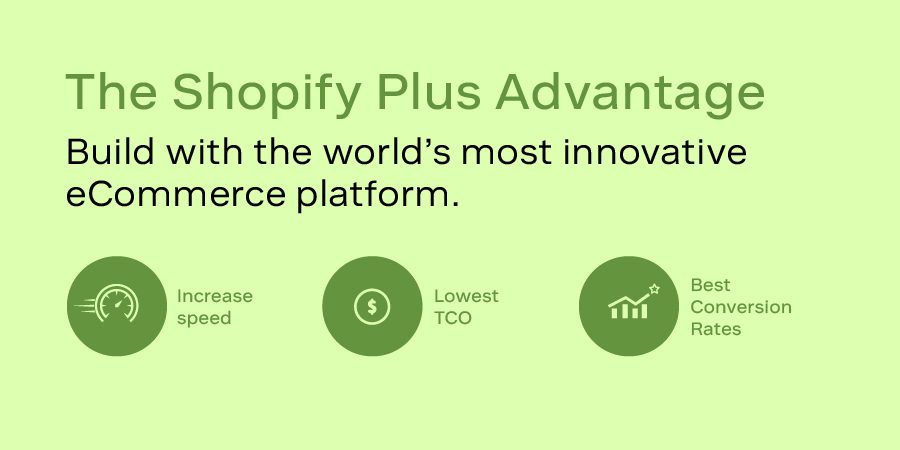
This is really where Shopify Plus outstrips the competition.
With Shopify Plus, costs are predictable, and you can run with a leaner team, than comparable Adobe builds. Integrations tend to be smoother too: a mature app ecosystem and solid APIs/webhooks mean you buy more and build less, which cuts down on fire drills.
And Shopify handles the heavy lifting; PCI, DDoS/WAF, autoscaling so your team doesn’t have to.
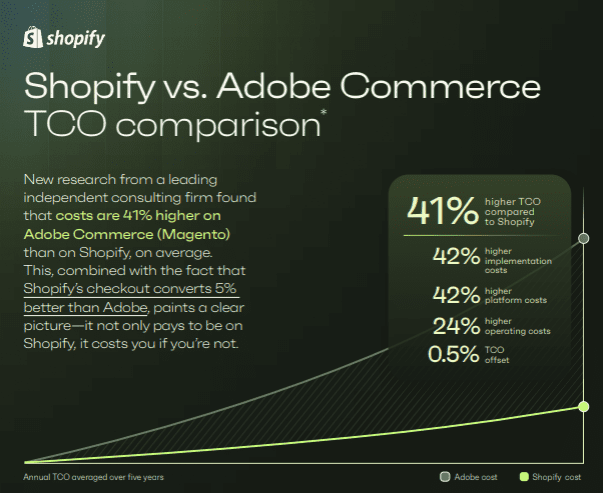
With Adobe Commerce, license fees scale with your GMV and the edition you choose, and builds usually cost more to implement and maintain because of customization and DevOps. You’ll also need to budget for ongoing performance tuning, security patching, and steady feature work.
Calculate TCO
Select your revenue range and current platform to see typical TCO differences versus Shopify. This view shows percentage gaps only—before operational and platform cost inputs.
Optional: show a quick $ estimate
Used only to translate the overall % savings into dollars. You can skip this to see percentages only.
Checkout and conversion
Shopify’s checkout is quick and proven, continually refined with insights from millions of orders. With Shop Pay and other accelerated wallets, the purchase flow gets simpler and conversion reliably climbs compared to a standard guest checkout.
And when you need tailored rules: like custom discounts, delivery options, or extra validations etc., you can add them safely with Checkout Extensibility and Shopify Functions without writing code and taking risks at the most critical stage.
Shop Pay consistently converts better than standard guest checkout, about 1.75x higher on desktop and up to 1.91x on mobile, based on Shopify’s analysis across millions of checkouts. With buyer details saved, customers can finish in seconds, which cuts drop off at the address and payment steps.
And with 100M+ shoppers storing credentials and Shop Pay available on Meta and Google surfaces, you tap into a large network that broadens reach while keeping checkout friction low.
Adobe Commerce gives you a highly customizable checkout where you control the steps, validations, and business logic. You can plug in a wide range of payment options through extensions and gateways and design the UX you want, but you’ll need to stay on top of performance tuning and most importantly, security, and that’s a big responsibility.
Best platform for B2B: Shopify Plus vs Adobe Commerce
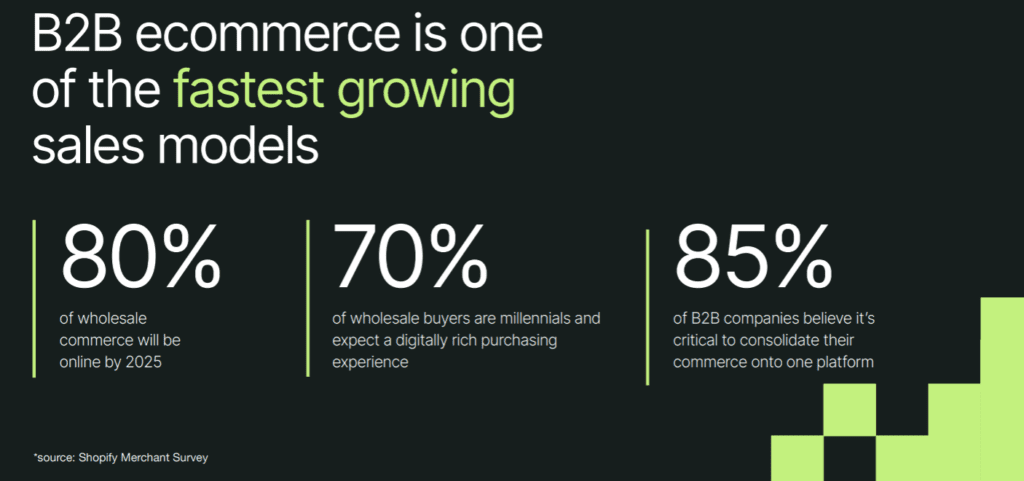
Run B2B and DTC on the same platform to streamline operations, keep your brand consistent, and cut development costs.
You can launch a B2B storefront in weeks, not months, on a composable framework that improves continuously with hundreds of updates each year. Need wholesale features? Turn on product bundles, set targeted discounts, and automate approvals, assignments, and notifications with Shopify Flow. Connect your ERP and OMS to sync price lists, inventory, and terms, and you get an enterprise grade setup without the enterprise drag.
Shopify gives you what you need out of the box to tailor the experience for every buyer. Build curated catalogs, set custom pricing, personalize storefronts, offer flexible payment terms, and give customers a clean self serve portal for reorders and account management. With more than 20 years in commerce, Shopify helps B2B brands move fast on a platform built for omnichannel growth.
Adobe Commerce is a fit for B2B teams that need deep control and strict governance. The tradeoff is weight. Implementations run longer, you rely on engineers for custom logic and upgrades, and release management, patching, and performance tuning sit with your team. Extensions can clash and need extra QA, and total cost of ownership is usually higher than a SaaS model.
Performance and security at peak
Shopify handles performance and security, so big product drops and seasonal peaks are mostly a non-event on Shopify Plus. The platform auto-scales and uses a global CDN to keep everything fast. Shopify also takes care of security hardening, patching, and compliance, which lowers risk and saves your team from surprise maintenance work.
On Adobe Commerce (Magento), traffic spikes are not hands off. You need to plan capacity with your host or Adobe Commerce Cloud, tune Varnish, Redis, and the database, pre-warm caches, and run load tests before major drops. Autoscaling is not a simple switch, and a miss can show up as slow pages or checkout hiccups. CDNs are supported, but setup and upkeep are on you. Security and compliance are too: apply Magento patches, keep PHP and libraries current, manage a WAF, and control PCI scope. Adobe’s cloud adds guardrails, but you still own the app and most of the operational work, while Shopify handles that for you.
Global growth without the sprawl
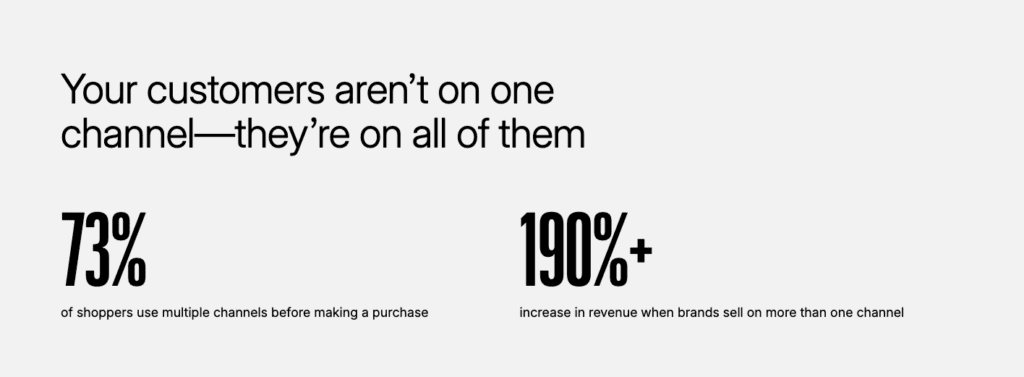
Shopify Markets takes on most of the cross border work. You get multi currency, duties and taxes, and localized storefronts without building a sprawling multi store setup. You keep one source of truth for governance, while each region can tailor content, pricing, and inventory to its market.
Adobe Commerce lets you run multiple stores and websites in different languages from a single codebase, with fine grained control over catalogs, pricing, and permissions. It is a strong fit for complex, multi brand, multi country operations where each market needs its own rules.
The tradeoff is overhead. With one codebase, a change for one brand can affect others, so the blast radius is larger. Releases slow down because every deploy needs coordination and QA across sites. You also own the routine work, including patches, upgrades, caching, indexing, and DevOps, while Shopify handles infrastructure, scaling, and security. Multi store setups add cache and index complexity that need constant tuning, especially at peak, whereas Shopify auto scales and hides most of that. Adobe Commerce extensions can also clash, and one bad interaction can ripple across all stores, while Shopify’s more standardized and vetted apps make conflicts less common and easier to contain.
Ecosystem and integrations
Shopify’s app marketplace is broad and well‑vetted, with solid options for subscriptions, search, loyalty, reviews, tax, shipping, and personalization, so you can plug in proven tools and see value faster than building from scratch.
On top of that, a deep network of agency and tech partners helps you move quicker and keeps vendor risk down.
Adobe’s eco system is large too, but conflicts between modules can slow you down, and you’ll lean on developers more often to tweak or fix things. The partner ecosystem is strong, but projects tend to be heavier, with longer timelines and higher delivery costs because you’re customizing and maintaining more of the stack. If you truly need deep, bespoke backend logic, Magento’s flexibility is a plus, but you’ll pay for it in complexity, testing, and ongoing maintenance compared with plugging in well‑vetted Shopify apps and moving on.
Best for multi-country ecommerce
Shopify Plus is built for global DTC and straightforward multi‑region rollouts. You get clean tools for currencies, duties, taxes, and localization, so it’s easy to stand up and manage multiple storefronts without dragging around a heavy multi‑website codebase.
Every Shopify plan comes with a solid set of international tools that make going global straightforward: tailor themes by region, localize content quickly, use custom domains or subfolders for localized URLs, and set market‑specific pricing.
You also get best‑practice recommendations, checkout forms that adapt to local address formats, market‑specific product catalogs, and a single multi‑market dashboard to manage it all, perfect alongside Shopify Markets.
Adobe Commerce handles international well, but it leans on multi‑website/store/store‑view architecture and more hands‑on config. You can run different languages, currencies, tax rules, and catalogs with fine control, but you’ll typically spin up separate store views, wire in extensions for duties/import taxes and translation management, and spend more time on setup and QA.
Data, analytics, and marketing velocity
Shopify makes reporting and optimization straightforward. Built in analytics, simple integrations with GA4, CDPs, and BI tools, and ShopifyQL Notebooks give you quick answers. Plus features like Shopify Audiences (where available) can improve acquisition efficiency out of the box.
Adobe’s analytics approach is strongest if you are already invested in Experience Cloud, including Adobe Analytics, Target, and AEP, and you want tight custom integrations. That stack usually adds cost, complexity, and specialist headcount. If you are not committed to Adobe’s suite, Shopify generally gets you to insights and action faster.
When is Adobe Commerce the only viable option?
- Your roadmap depends on custom data models, unusual order flows, or entirely bespoke promotion logic within the commerce core.
- You run very complex, divergent B2B or multi-brand governance that must be modeled in a single backend with heavy customization.
- You have an in-house engineering organisation prepared for ongoing patching, upgrades, performance tuning, and release management.
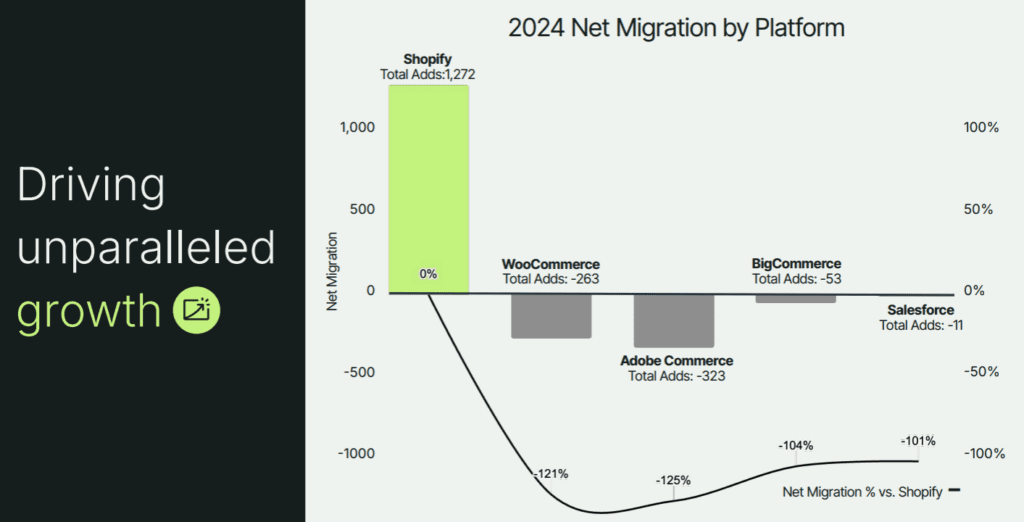
Why do companies migrate from Magento to Shopify Plus?
- Need to launch globally and iterate fast with a lean team? Shopify Plus.
- Want the highest-converting, continuously optimized checkout with upgrade-safe customizations? Shopify Plus.
- Prefer predictable costs over building and maintaining infrastructure and a large engineering team? Shopify Plus.
- Running modern DTC or mainstream B2B with clear price lists and catalogs? Shopify Plus.
- Require highly bespoke backend logic and complex multi-entity governance in one codebase? Consider Adobe Commerce—along with the added operational investment.
Conclusion
Both platforms can handle enterprise scale, but they optimize for different realities. Shopify Plus favors speed, reliability, and conversion with guardrails that keep you moving.
Adobe Commerce favors control, with the engineering and operational overhead that control entails. For most high-growth brands focused on rapid iteration, global expansion, and strong unit economics, Shopify Plus delivers more value sooner and sustains it with a lower total cost of ownership.

Digital Marketing Manager at Aware Group: Working his way through the world of technology and Thailand as best as he can. Happy to contribute to other tech publications.