Thought leadership · Guest contribution by Derek van Pelt · Part 2 of 3
This three-part series explains why Thai SMEs must modernize now and shows how ERP, cloud, and AI can tackle tomorrow’s challenges.
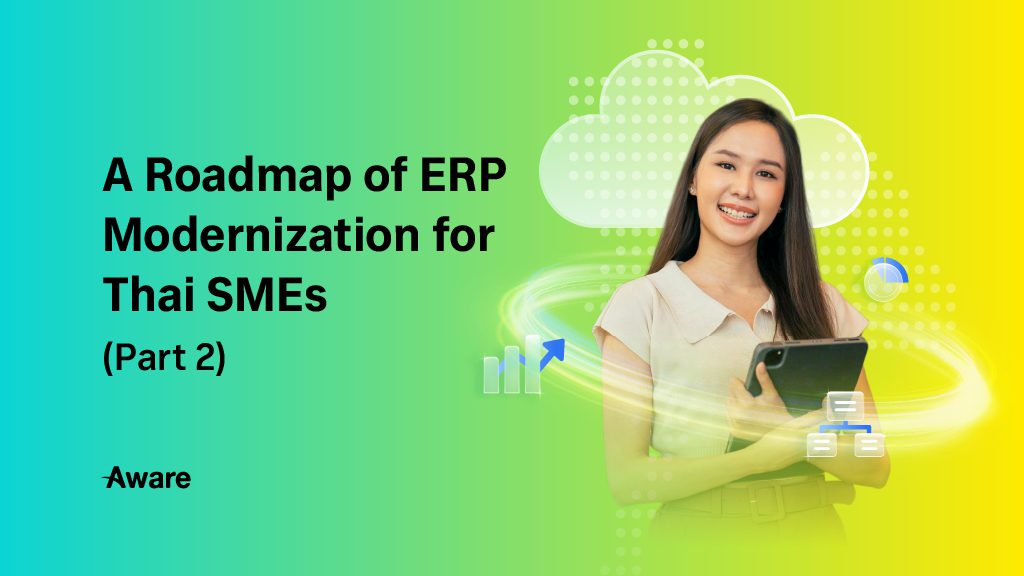
This is Part 2—how SAP Business One on AWS becomes the SME operating system, centralizing data and delivering scalable, secure cloud economics for Thai SMEs.
Catch up: Part 1 — Thailand’s Modernization Imperative for SMEs · Read next: Part 3 — AI on SAP B1: Predictive Inventory, RAG Agents, and a 12‑Month Roadmap
2. The Digital Core: SAP Business One as the SME Operating System
For leaders who want to beat these macroeconomic challenges, an Enterprise Resource Planning (ERP) system that brings together functionality and agility is one of the best options. SAP Business One (SAP B1) is designed to fit this bill, an antithesis to complex, monolithic SAP architecture that’s used by global conglomerates. 1
2.1 Centralization of the Data Estate
Again, for those familiar with how many Thai SMEs operate, it’s clear that most data lives in silos because of how they’ve developed, grown, and been managed. Leaders use accounting systems on legacy software, manage inventory in spreadsheets, and hunt for customer data scattered across personal messaging apps like LINE or WhatsApp. The fragmentation makes advanced analytics impossible, but SAP B1 acts as a single source of truth, bringing together Finance, CRM, Warehousing, Production, and Purchasing all into a unified dashboard. 1
Secondary to this oversight, but just as importantly, centralization is a prerequisite for any future that can take advantage of Artificial Intelligence. AI models, whether predictive or generative, demand structured, clean, and accessible data. By bringing operations and data together into SAP B1, SMEs will create the data lakes needed to create useful single/ multi-shot examples, or train & fine-tune in-house AI models. 2
2.2 Agility and Scalability vs. Competitors
While competitors like Odoo offer modularity and open-source flexibility, SAP B1 allows for structured reliability for growing SMEs that want to compete in export markets or who may be eyeing an IPO. 3 The “structure” of SAP B1 enforces industry best practices, which can be a useful constraint for Thai family businesses that are both interested in professionalizing their operations and which may need to manage stakeholder challenges to revisiting “the way things have always been done.”
Compared to lighter solutions like Zoho, SAP B1 provides the depth needed for companies that will require complex manufacturing and inventory management, including Bill of Materials (BOM) explosion, production route planning, and multi-warehouse synchronization, even if those needs may not be on the immediate roadmap. 4 The features are essential (but sometimes unconsidered, early in a company’s growth) for Thai manufacturers that want to participate in global supply chains where traceability and compliance are non-negotiable. 5
2.3 The “Intelligent Enterprise” Vision
SAP’s roadmap for B1 allows for the concept of an “Intelligent Enterprise,” which goes beyond transaction processing to embedded intelligence. Features like the Service Layer API allow for modern, RESTful connectivity to external systems, enabling the ERP to act as a central control center that manages subsystems like e-commerce platforms, IoT sensors, and logistics providers effectively. 6 This connectivity is also what allows for simplified integrations with AWS, giving opportunities to create hybrid architectures that bring together the stability of SAP with an ability to innovate at the speed of the cloud effectively.
3. AWS as the Enabler of Sovereignty and Scale
The decision to host SAP B1 on Amazon Web Services (AWS) can be a useful financial pivot from Capital Expenditure (CAPEX) to Operational Expenditure (OPEX), good news for SMEs that need to preserve cash flow. 7
3.1 The AWS-SAP Joint Reference Architecture
The partnership between SAP and AWS has created a joint reference architecture that standardizes how the two systems work together. It ends up being more than running a Virtual Machine (EC2) with SAP installed, and involves a set of services that work well together:
- Compute (Amazon EC2): High-performance instances (e.g., R5, X1) certified for SAP HANA ensure that the in-memory database delivers peak performance, handling large datasets without latency. 8
- Storage (Amazon S3 & EBS): Reliable, scalable storage for backups and data lakes. Amazon S3 becomes the centralized collection point for data that’s been pulled from SAP, making it ready for AI analysis. 9
- Connectivity (AWS Direct Connect & VPC): Secure, private networking that goes beyond an SME’s network to the cloud, keeping data local, secure, and in compliance with the Thai Personal Data Protection Act (PDPA). 8
3.2 Elasticity for Seasonal Businesses
Thailand’s economy (particularly the services sector) is heavily seasonal. A hotel chain in Phuket or a souvenir manufacturer in Chiang Mai sees demand spikes during the high season (November-February) and then has to suffer demand troughs during the monsoon.
- The On-Premise Trap: In a traditional setup, the business must buy servers capable of handling its peak load. During the low season, half or more of this capacity often sits wastefully idle.
- The AWS Solution: On AWS, infrastructure is elastic, meaning you only need to use as much of it as you need at any given time. This allows for scaling up needs during peak seasons to handle high transaction volumes and then scaling back down again during periods of lower demand. This alignment of cost with revenue is the definition of cloud economics. 7
3.3 Security and Disaster Recovery
For Thai SMEs, unfortunately, data security is often an afterthought until a breach occurs. Ransomware attacks are rampant in the region. AWS provides cloud disaster recovery services that would be out of reach for almost any small company trying to do it by itself. Using services like AWS Elastic Disaster Recovery, an SME can keep a “warm standby” of their SAP environment in a different Availability Zone or Region. In case of a ransomware attack or physical disaster (like a flood, or a fire), the ERP can failover to the cloud almost instantly, allowing for business continuity. 7 Aware’s expertise in managed services is incredibly valuable here, as they are able to configure these complex security setups for clients. 10
References
- Aware — What is SAP Business One?
- Aware — AWS Success Story: BeWish SAP B1
- Aware — SAP Business One vs Odoo
- Aware Blog — Technology News (SAP B1 capabilities)
- Case Study — SAP Business One Inventory
- AWS Docs — Amazon Bedrock Agent (SAP Guides)
- Aware — Cloud Migration Services (CAPEX→OPEX)
- AWS Docs — Architecture Guidance for SAP on AWS
- AWS for SAP Blog — Secure & Scalable GenAI with AWS and SAP
- Aware — Artificial Intelligence Articles
Next in the series: Part 3 — AI on SAP B1: Predictive Inventory, RAG Agents, and a 12‑Month Roadmap

Derek is an entrepreneur, investor, director, advisor based in Southeast Asia since 1997, focusing on early-stage investment, corporate governance, and cross-border business development.