

October 30, 2026
12 Lessons from Aware Dialogues EP.2 Leader x AI: The Leader AI Can’t Replace
Leaders in the age of AI don’t need to be more tech-savvy than everyone on their team. They need to do what AI still can’t: build trust, bring people through change together, and make the team feel safe enough to learn something new.
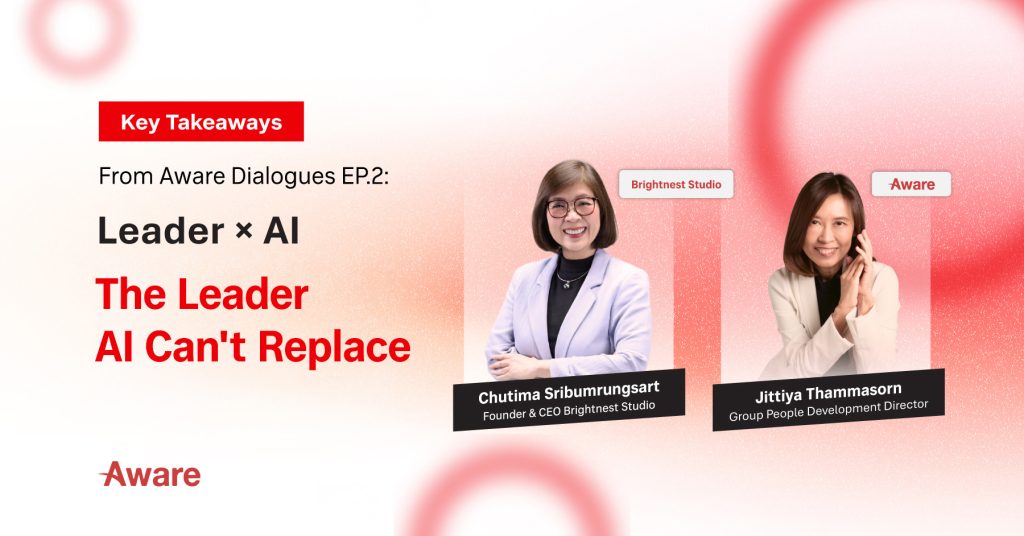
These are the takeaways from Aware Dialogues EP.2: Leader x AI | The Leader AI Can’t Replace, where Jittiya Thammasorn (Group People Development Director, Aware Group) invited Chutima Sribumrungsart (Founder & CEO of Brightnest Studio and former CHRO of Microsoft Thailand) for a conversation that then opened up into a Circle Talk, with participants sharing their own perspectives, on 26 October.
Chutima set the frame early on: AI processes data fast, but people are the ones who give value and meaning to the work they deliver. Calculations, pattern analysis and automation can be left to machines. Trust, relationships, empathy and ethical judgment are still human work.
So what does that look like in practice? Many organizations have already started using AI, but what holds them back usually isn’t the tools. Teams still don’t see why they’re changing. Some managers still feel they have to know more than their people in order to lead. And remote work has pulled teams further apart than before.
Below are 12 takeaways from the conversation, from the role of a manager and getting the order of people, process and technology right, to communicating when projects change because of AI. We close with 5 things Chutima urges leaders to actually do. Here they are.
12 Lessons from Aware Dialogues EP.2 Leader x AI: The Leader AI Can’t Replace
1. AI Still Can’t Replace Leaders (People) at the DNA Level
AI is machine learning that learns from what people feed it. We are human beings, the ones who create and teach. If we don’t teach it, it will never know. What can’t be replaced right now is the “DNA of being human.” Technology can handle parts of the work, not the whole system. That could change in the future, if human skills can truly be fully extracted into systems. For now, we may not be there yet.
2. A Manager Doesn’t Have to Be Better Than Their Team
Many managers carry an old belief that they need to be more skilled or more senior to lead a team. In reality, no manager has every area covered. What they do need to do is turn their team’s talent into real results and genuinely help people get better.
3. An “AI Organization” Still Needs People to Drive It
Transformation stands on three pillars: people, process and technology. People need a mindset that’s ready to learn and to put new things into practice. Then there need to be processes that prepare people step by step to reach the goal. Only then can technology really move forward. The order matters a lot. Skip straight to technology without people and processes to support it, and you won’t get far.
4. Culture and Transformation Are a Journey
Organizations need to adapt much faster than before. When expectations have shifted but people haven’t, the problem can’t be solved. That’s why culture matters so much. Transformation is a journey everyone has to be part of, learning and understanding together. Leaders need to help shape people’s mindsets and the way they learn, so everyone moves in the same direction.
5. Where Managers Should Start When They Want Their Team to Use AI Well
Managers have the authority to set direction when implementing AI, and it starts with two things. First, be able to answer what you want to change and why, so the team believes in it and sees a shared goal. Second, check whether the team is ready. Is AI being used in a garbage-in, garbage-out way? Is there enough critical thinking and AI literacy? From there, everything needs a clear purpose.
6. Don’t Divide People by Generation. Think Individual Inclusion.
Building on point 4, when the discussion turned to communicating and giving clear instructions, Gen Z came up as an example of a group often seen as stubborn, impatient and hard to work with. But age or generation shouldn’t be used to divide people on a team. Think in terms of individual inclusion instead. If we understand Gen Z, we’ll see they are very clear about who they are, because they grew up learning a lot on their own online. So when assigning them work, instructions need to be clear, not vague. They also want to do meaningful work and create something for the organization. Once they understand, they take ownership and deliver well. In the end, when we understand the differences between individuals, we communicate better.
7. Human Touch Is What’s Missing in the AI and Remote Work Era
Many HR professionals agree that today’s work environment lacks human touch, which makes connection and bonding within teams feel more distant. Leaders need to take the lead here, to keep bringing everyone back to work together. That means:
- Having empathy and understanding the context of the people you interact with
- Being willing to help and using engagement skills to bring people together
- Being able to orchestrate the environment
- Understanding people in their own context (decode/sit in others’ shoes)
- Building psychological safety so the team feels safe and feels they belong, enough to raise concerns instead of keeping problems to themselves, and to take more ownership of their work
The end goal is real impact, measured by whether the team feels cared for and supported.
8. Hiring in the AI Era: Look for Common Values, Not “the Perfect Fit”
The job market and selection process are changing. You need to tell where people should be used and where tools should be used. These days there are tasks employees themselves don’t want to do, and if AI can do them more easily, use it there. As for people, we can’t always find someone who is both likable and the right fit. What we need are people with common values who want to move forward with the organization. A new hire’s integration or honeymoon period is crucial. Direction and purpose need to be clear to find common ground, and managers need to decide on fit quickly rather than letting it drag on as trial and error.
9. WFH or Office: Answer “What Do We Gain by Coming In?”
Set engagement protocols together; don’t let them happen on their own. At the start, managers and team members should meet in the office first. Once there’s confidence, WFH can be allowed, with monitoring or some in-person meetings each week. And every time people meet, ask “what’s the difference?” Coming in should benefit both the manager and the person who comes in. If people just come in and sit there, WFH is better. No time wasted commuting.
10. Change Management When Projects Change Because of AI
Always build the environment and the experience, and keep communicating. Say from day one that here, we learn all the time. Share the worst case too, not just the best case, so people understand why change is needed. But also know what help people need, and know each person’s learning style. Some don’t like being sent to training and prefer learning on their own through YouTube, so they keep learning. You may also need to guide them in advance on what they’ll need to know to reach the goal. Do we have readiness prepared for them at each stage of the journey? Smaller companies with less span need to do this even more.
When goals change, the path changes, and measurement has to change too instead of staying the same as before. Over-communicating is fine, because people need time to digest. Communicate it as a journey so everyone can plan it into their own work.
11. Sales: Trust Is What AI Still Can’t Replace
In sales, look at workability: what AI is suited for, and use it there. But AI can’t help build trust, relationships or engagement at all. Only people can do that.
12. To Win Executive Buy-in, HR Needs Data, Not Gut Feeling
HR needs to frame the problem correctly: what will genuinely solve it for the organization. Then bring market data to executives, with reference sources and benchmarks from the same industry. Who has done it? Did it work or not? Who has already started? What others say they’ve achieved may not match what they actually did, so dig deeper than what’s said. That may slow decisions down a little, but it may lead to better results.
Leader x AI: it all starts with ourselves. Lead yourself and put the individual first, then help the people around you grow, before coming together as one organizational ecosystem.
5 Things Leaders Must Do in the Age of AI
Khun Chutima summed it up as 5 priorities leaders need to act on to make what was discussed actually happen in the organization.
- Set Direction: Communicate the What and Why clearly, so everyone sees where we’re heading and has confidence in the change.
- Build Readiness: Create an AI Readiness Plan, develop new skills (reskill/upskill), and set KPIs that track progress.
- Enable People: Use empathy to understand employees’ concerns, remove obstacles, and make psychological safety real.
- Redesign Work: Be clear about which processes AI should handle and which still need human judgment.
- Sustain Transformation: Keep communicating, follow up closely, and build a culture of learning together.
All 5 rest on a shift in leadership behavior: from “the one who knows everything” to an orchestrator who brings together the strengths of each person (from know-it-all to learn-it-all). Leading with empathy. Seeing people as individuals instead of labeling them by generation. Treating AI as a partner that gives people time back for more valuable work. And staying people-first without worrying about over-communicating, because during a transition, when there’s too little communication, fear fills the gap.
The leader AI can’t replace, then, isn’t the one who knows the most or decides the fastest. It’s the one who sets direction, builds confidence, understands people, and helps everyone grow steadily through change.

- 12 Lessons from Aware Dialogues EP.2 Leader x AI: The Leader AI Can’t Replace - October 30, 2026
- Aware สานฝันและเปิดโอกาสให้ผู้ที่ต้องการย้ายสายงานมาเป็น Developer (ตอนที่ 2) - January 17, 2023
- Aware สานฝันและเปิดโอกาสให้ผู้ที่ต้องการย้ายสายงานมาเป็น Developer (ตอนที่1) - January 17, 2023
- จบไม่ตรงสายจะเปลี่ยนสายงานมาเป็น Developer ได้อย่างไร - January 17, 2023
- เราจะสร้าง Digital Footprint ที่เป็นมิตรต่อการสมัครงานได้อย่างไร - March 29, 2022
- Digital Footprint ร่องรอยบนดิจิทัลที่เราทิ้งไว้สำคัญแค่ไหน - March 9, 2022
- Hybrid Working – รูปแบบใหม่ของการทำงาน | Aware Group - December 7, 2021
- บางนา มามะ จะพาไปดู - November 12, 2021
- Project Leader! ผู้นำคนสำคัญที่จะพาทีมไปสู่ความสำเร็จ - November 3, 2021
- Pride Month 2021 | Aware People - June 2, 2021